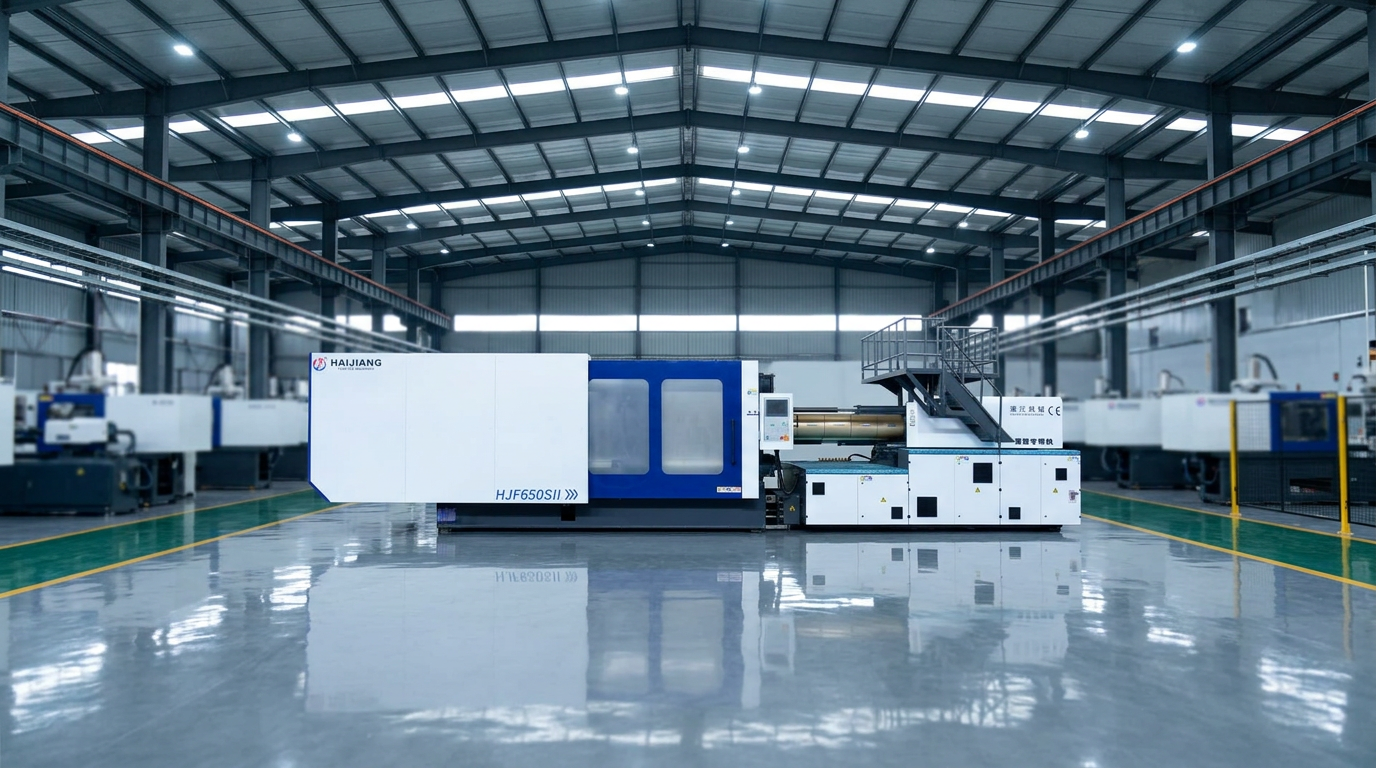
High-Precision Injection Molding Machines for Disposable Syringe Manufacturing
A syringe injection molding machine is one of the most important pieces of equipment in a disposable syringe manufacturing plant. It is used to produce plastic syringe components such as the syringe barrel, plunger, and other precision molded parts with high dimensional accuracy, repeatability, cleanliness, and production efficiency. Haijiang specializes in manufacturing injection molding machines for medical plastic products and can configure machines for different syringe sizes, mold cavities, production capacities, and automation requirements. For syringe manufacturers, choosing the right injection molding machine is not simply a matter of machine tonnage. The machine must match: Syringe component design Mold cavity quantity Mold dimensions Plastic material Shot weight Clamping force Injection pressure Cycle time Production capacity Clean production requirements Robot automation Energy consumption Long-term production stability A properly configured syringe molding system can significantly reduce production cost while improving product consistency and manufacturing efficiency.
What Is a Syringe Injection Molding Machine?
A syringe injection molding machine is an injection molding system specifically configured for manufacturing plastic parts used in disposable medical syringes. Typical molded syringe components include: Syringe barrel Syringe plunger Luer slip barrel Luer lock barrel Insulin syringe components Safety syringe components Auto-disable syringe components Oral syringe components Other medical plastic parts The injection molding machine melts medical-grade polymer resin and injects it into a precision multi-cavity mold. After cooling, the molded parts are automatically ejected and can be transferred by robots or conveyors to downstream processes such as: Injection Molding → Component Handling → Printing → Assembly → Inspection → Packaging → Sterilization Because syringe components require tight tolerances and stable dimensions, the performance of the injection molding machine has a direct impact on the final syringe quality.
Haijiang Syringe Injection Molding Machine
Haijiang injection molding machines can be configured for syringe production ranging from small-capacity production lines to high-output medical device factories. Typical applications include: Application Typical Machine Configuration Syringe plunger molding Small to medium injection molding machine Syringe barrel molding Medium injection molding machine 1 ml syringe High-precision molding configuration 2 ml / 3 ml syringe Multi-cavity production 5 ml syringe Multi-cavity production 10 ml syringe Medium-high shot volume 20 ml syringe Larger mold and shot volume 50/60 ml syringe Larger clamping and injection unit Insulin syringe High precision medical molding Safety syringe Multi-component molding configuration The final machine model should always be selected according to the actual mold and component design rather than syringe volume alone.
Why Syringe Manufacturing Requires a High-Precision Injection Molding Machine
Disposable syringes appear simple, but their plastic components require very consistent molding. For example, the syringe barrel must maintain accurate: Internal diameter Wall thickness Luer dimensions Flange geometry Barrel roundness Transparency Surface finish The plunger must also maintain consistent dimensional tolerances so that the assembled syringe achieves appropriate sliding performance and sealing. A poorly controlled molding process may result in: Flash Short shots Sink marks Warpage Black spots Flow marks Dimensional variation Poor transparency Excessive burrs Assembly problems Leakage Poor plunger movement For this reason, medical syringe factories generally require injection molding machines with stable control of: Injection pressure + injection speed + plasticizing + mold temperature + clamping force + cycle repeatability.
Syringe Barrel Injection Molding Machine
The syringe barrel injection molding machine is normally one of the most important machines in the syringe production line. The barrel is typically molded from medical-grade polypropylene because polypropylene provides a good combination of: Transparency Chemical resistance Processability Low density Sterilization compatibility Mechanical stability Cost efficiency During barrel molding, special attention should be paid to: Transparency The molded barrel must provide sufficient visibility so users can observe the liquid and dosage markings. Improper molding parameters can reduce transparency or create visible defects. Dimensional consistency The internal barrel diameter has a direct relationship with plunger movement and sealing performance. Luer accuracy The syringe tip or Luer connection must maintain accurate geometry to ensure connection compatibility. Flash control Excessive flash may interfere with assembly and product safety. Cycle stability Large-scale syringe factories often operate continuously for long periods, making repeatable molding cycles essential. Syringe Plunger Injection Molding Machine The syringe plunger is another major injection molded component. Depending on syringe design, the plunger may work together with: Rubber gasket Elastomer seal Integrated sealing structure The injection molding machine for the plunger must maintain stable component dimensions because even small variations can affect syringe assembly and plunger sliding resistance. Important molding factors include: Straightness Rib dimensions Plunger length Surface quality Mold filling balance Shrinkage control Ejection stability High-cavity molds are frequently used for large-volume syringe production.
How Does a Syringe Injection Molding Machine Work?
The syringe injection molding process consists of several stages. 1. Raw Material Feeding Medical-grade polypropylene resin is supplied to the injection molding machine. Depending on factory configuration, the material handling system may include: Material hopper Vacuum loader Central material feeding system Dryer when required Dust protection system Automatic material distribution In medical manufacturing, material cleanliness and traceability are particularly important. 2. Plasticizing Plastic pellets enter the heated barrel of the injection molding machine. The rotating screw moves, compresses, heats, and melts the polymer until a homogeneous melt is formed. Stable plasticizing is important because inconsistent melt temperature can cause variations in: Filling Shrinkage Transparency Product weight Mechanical properties 3. Injection The molten polymer is injected into the syringe mold at controlled speed and pressure. Modern servo-controlled injection molding machines allow precise adjustment of different injection stages. Proper control helps achieve balanced filling across multi-cavity syringe molds. 4. Holding Pressure After cavity filling, holding pressure compensates for material shrinkage during cooling. This stage is particularly important for maintaining consistent syringe component dimensions. 5. Cooling The plastic cools inside the mold until the part has sufficient rigidity for ejection. Mold cooling design has a major influence on production cycle time. Efficient mold temperature control can therefore increase overall syringe production capacity. 6. Mold Opening and Ejection After cooling, the injection molding machine opens the mold. Molded syringe parts are removed through: Automatic ejection Servo robot Pneumatic robot Take-out robot Conveyor system For medical production, automated handling is generally preferred because it reduces unnecessary human contact. 7. Automatic Transfer The molded components can be transferred automatically to collection containers or subsequent processing equipment. A highly automated syringe factory may use: Injection molding → Robot take-out → Conveyor → Component storage → Assembly machine This reduces labor requirements and contamination risk.
Complete Syringe Injection Molding Process
A typical syringe component production process can be represented as: Medical-grade PP Resin ↓ Automatic Material Feeding ↓ Injection Molding Machine ↓ Multi-cavity Syringe Mold ↓ Robot Part Removal ↓ Visual Inspection ↓ Component Collection ↓ Printing / Assembly ↓ Primary Packaging ↓ Sterilization ↓ Finished Disposable Syringe The exact process depends on syringe design and factory automation level.
What Plastic Is Used for Syringe Injection Molding?
Medical-Grade Polypropylene Polypropylene, commonly abbreviated as PP, is widely used for disposable syringe barrels and plungers. Typical reasons include: Good transparency Low weight Suitable stiffness Good chemical resistance Excellent injection moldability Competitive material cost Compatibility with many sterilization processes Medical device manufacturers should use material that complies with the regulatory and technical requirements applicable to their target market. Other Materials Used in Medical Syringe Manufacturing Depending on syringe type, other materials may include: Polyethylene Used for selected components and medical plastic applications. TPE / Elastomer Materials Used for certain sealing components. Rubber Commonly used for syringe gaskets. COP and COC Cyclo Olefin Polymer and Cyclo Olefin Copolymer are increasingly used in higher-value pharmaceutical and prefilled syringe applications. These materials require different molding technologies and should not be treated exactly like conventional disposable PP syringes.
Syringe Injection Molding Machine Components
A syringe molding machine generally consists of several major systems. Injection Unit The injection unit melts and injects polymer into the mold. Important parameters include: Screw diameter Injection volume Shot weight Injection pressure Injection speed Plasticizing capacity Clamping Unit The clamping unit keeps the mold closed during injection. Important parameters include: Clamping force Tie-bar spacing Mold thickness Opening stroke Ejector stroke Platen dimensions Servo Hydraulic System Modern syringe production can benefit significantly from servo-driven hydraulic systems. Advantages may include: Reduced energy consumption Stable process control Lower oil temperature Reduced operating noise Faster response Improved repeatability For factories running injection molding equipment many hours per day, energy consumption becomes an important component of total syringe production cost. Control System The control system allows operators to manage: Injection speed Injection pressure Holding pressure Screw rotation Back pressure Mold opening Mold closing Ejection Temperature zones Production cycle Alarm history Process parameters Process recipe storage is useful when producing multiple syringe sizes or different molded components.
How to Select the Right Syringe Injection Molding Machine
Machine selection should begin with the mold. This is extremely important. Do not select a machine simply by saying: “I want to produce a 5 ml syringe.” Two factories producing the same 5 ml syringe may use completely different mold cavity quantities and therefore require different injection molding machines. The correct selection process is: Syringe Design → Mold Design → Cavity Quantity → Shot Weight → Mold Dimensions → Clamping Force → Injection Unit → Machine Model 1. Syringe Size Common disposable syringe sizes include: 1 ml 2 ml 2.5 ml 3 ml 5 ml 10 ml 20 ml 30 ml 50 ml 60 ml Different component sizes require different shot volumes and mold configurations. 2. Mold Cavity Quantity Production molds may contain: 8 cavities 16 cavities 24 cavities 32 cavities 48 cavities 64 cavities 96 cavities 128 cavities or other custom cavity arrangements. More cavities can increase output per cycle but may also require: Larger mold dimensions Higher machine clamping force Larger shot volume Better filling balance More advanced hot runner systems Higher mold investment Therefore, the highest cavity count is not automatically the most economical solution. 3. Shot Weight The injection unit must provide enough material for all molded parts plus runner volume where applicable. A basic calculation is: Total Shot Weight = Weight per Part × Number of Cavities + Runner Weight The recommended injection volume should generally include appropriate process margin rather than operating continuously at the absolute maximum capacity of the machine. 4. Mold Dimensions Machine platen size and tie-bar spacing must accommodate the syringe mold. Important values include: Mold width Mold height Mold thickness Tie-bar spacing Maximum mold opening Minimum mold height A machine may have sufficient clamping force but still be unsuitable if the mold physically cannot fit inside the clamping unit. 5. Clamping Force Required clamping force depends on several parameters, particularly projected molding area and cavity pressure. A simplified concept is: Required Clamping Force ≈ Projected Area × Cavity Pressure A safety factor is usually included during engineering selection. Actual selection should be calculated from the real mold data. 6. Injection Pressure Thin-wall syringe components can require relatively fast and controlled filling. Adequate injection pressure helps ensure complete filling of all mold cavities. The machine should not only provide sufficient maximum pressure but should also maintain stable pressure during repeated high-volume production. 7. Production Cycle Time Cycle time has a direct impact on production output. For example, reducing the molding cycle from 15 seconds to 12 seconds can significantly increase yearly output. However, pursuing an excessively short cycle can cause: Insufficient cooling Warpage Dimensional instability Poor transparency Increased rejects The optimum cycle should balance speed and product quality.
Syringe Production Capacity Calculation
Injection molding capacity can be estimated using: Hourly Output = Mold Cavities × 3600 ÷ Cycle Time in Seconds Example: If a syringe barrel mold contains 32 cavities and operates at a 12-second cycle: 32 × 3600 ÷ 12 = 9,600 barrels/hour At 20 operating hours per day: 9,600 × 20 = 192,000 barrels/day Actual factory output should consider: Machine downtime Mold maintenance Material changes Reject rate Operator breaks Preventive maintenance Production efficiency Therefore, theoretical capacity and practical capacity should always be distinguished. Example: 32-Cavity Syringe Mold Assume: 32 cavities 12-second cycle 20 production hours/day 300 production days/year 85% overall production efficiency Theoretical hourly production: 9,600 pcs/hour Annual practical output: 9,600 × 20 × 300 × 85% ≈ 48.96 million pieces/year This demonstrates why mold cavity number and cycle time can have a greater influence on output than simply choosing a larger injection molding machine.
Energy Consumption of Syringe Injection Molding Machines
Factory investors should not evaluate machines only by purchase price. The real cost consists of: Machine Purchase Cost + Electricity + Cooling + Maintenance + Labor + Spare Parts + Downtime A lower-priced machine with higher electricity consumption or frequent downtime may eventually cost more. When comparing syringe injection molding machines, ask suppliers to provide: Installed motor power Servo system configuration Heater power Typical operating power Cooling requirement Pump configuration Oil capacity Maintenance requirements Where possible, machine comparisons should be based on actual production conditions rather than nominal motor power alone. Why Energy Efficiency Matters in Syringe Factories Consider a factory operating several injection molding machines for: Syringe barrels Plungers Needle hubs Protective caps Additional plastic components The injection molding section may become one of the major electricity consumers in the factory. Over years of production, energy consumption directly affects: Cost per Syringe. For manufacturers competing in cost-sensitive markets, energy-efficient machinery therefore provides strategic value beyond environmental benefits.
Syringe Mold and Injection Molding Machine Matching
The mold and machine should be engineered as one molding system. An ideal matching process evaluates: Mold Parameters Mold size Mold weight Cavity quantity Hot runner design Cooling system Gate type Projected area Required opening stroke Product Parameters Component dimensions Part weight Wall thickness Polymer Required tolerances Machine Parameters Clamping force Injection volume Screw diameter Injection pressure Tie-bar spacing Opening stroke Ejector capacity Selecting the machine before receiving mold information may lead to oversized or undersized equipment. Hot Runner Syringe Molds High-volume syringe manufacturing often uses hot runner molds. Potential advantages include: Reduced runner waste Lower raw material consumption More automated production Improved cavity filling Reduced secondary handling Lower material recycling requirements However, hot runner systems require: Accurate temperature control Good mold design Reliable heating components Proper maintenance Balanced flow channels The economic advantage becomes more significant as production volume increases. Cold Runner vs Hot Runner Syringe Molds Factor Cold Runner Hot Runner Initial mold cost Lower Higher Runner waste Higher Low Automation Moderate High Material efficiency Lower Higher Maintenance complexity Lower Higher Best application Small/medium production High-volume production The most economical solution should be evaluated based on annual production quantity and material cost.
Automation for Syringe Injection Molding
Automatic part handling can greatly improve syringe production. A typical automatic molding cell may include: Injection molding machine Servo robot Conveyor Static elimination Vision inspection Automatic counting Component collection Central material feeding Benefits include: Reduced labor Less manual contact Consistent production Easier material handling Improved cleanliness Better traceability Robot for Syringe Injection Molding Machine A robot can automatically remove molded components from the mold. Depending on application, the system may use: Three-axis robot Servo robot High-speed side-entry robot Custom take-out system High-output multi-cavity syringe molds may benefit from faster robotic handling to minimize mold-open time. The robot cycle should be synchronized with the injection molding machine.
Syringe Injection Molding in a Clean Production Environment
Medical plastic molding requires greater attention to environmental control than general-purpose plastic manufacturing. Depending on factory design and regulatory strategy, molding can be performed: Inside a controlled molding area Adjacent to a cleanroom In a clean manufacturing environment With enclosed automatic transfer into downstream clean areas The appropriate cleanroom classification depends on product, process, packaging state, regulatory requirements, sterilization method, and quality system. Machine configuration may also include features that facilitate cleaner manufacturing such as: Easy-to-clean surfaces Reduced oil leakage risk Controlled lubrication Enclosed part handling Automatic material feeding Robot take-out Reduced manual contact
Medical Injection Molding Machine Requirements
When an injection molding machine is intended for medical production, buyers should evaluate more than basic machine performance. Important considerations include: Repeatability Medical parts need stable dimensions over long production runs. Process Stability Injection pressure, speed, temperature, and clamping must remain consistent. Cleanliness Machine design should support controlled production environments. Traceability Process parameter monitoring and recipe management can support production documentation. Reliability Downtime can disrupt assembly, packaging, and sterilization schedules. Energy Efficiency Electricity consumption directly affects cost per syringe.
Syringe Manufacturing Machine vs Syringe Injection Molding Machine
These two terms are related but not identical. A syringe injection molding machine produces plastic syringe components. A complete syringe manufacturing line may include: Injection molding machine Syringe mold Barrel printing machine Syringe assembly machine Needle assembly equipment Silicone oil application system Inspection system Blister or pouch packing machine EO sterilization system Therefore: Injection molding machine = one major production process while Syringe manufacturing line = complete manufacturing system Disposable Syringe Manufacturing Process A typical disposable syringe production process includes: Stage 1 – Plastic Component Molding Syringe barrels and plungers are injection molded. Stage 2 – Barrel Printing Graduation markings and other required information are printed on the barrel. Stage 3 – Syringe Assembly The barrel, plunger, gasket, needle components, and other parts are automatically assembled. Stage 4 – Inspection Products are inspected for defects. Stage 5 – Packaging Individual syringes are packed in: Blister packs Medical paper pouches Other validated sterile barrier systems Stage 6 – Sterilization EO sterilization is widely used for disposable syringe products. The final manufacturing process depends on product design and local regulatory requirements.
Injection Molding Machine for 1 ml Syringe
Small-volume syringes such as 1 ml syringes often require high dimensional precision. Applications may include: Tuberculin syringes Insulin-related products Low-volume medication delivery Specialized syringes Machine configuration depends strongly on cavity number and mold design.
Request a Syringe Injection Molding Machine Proposal
If you are planning a new syringe manufacturing project or expanding an existing syringe factory, send Haijiang the following information: Syringe type Syringe sizes Product drawings Mold information Annual production capacity Production hours Destination country Required automation level Our engineering team can evaluate the project and recommend: Injection molding machine model Clamping force Injection unit Mold cavity configuration Robot Auxiliary equipment Estimated molding capacity Utility requirements Contact Haijiang for a syringe injection molding machine configuration based on your actual production requirements.
- · Send the product drawing, sample photo or reference product
- · Tell us the plastic material, product weight and cavity number
- · Our engineers reply with a machine recommendation and quotation
Injection Molding Machine for 2 ml and 3 ml Syringes
2 ml and 3 ml syringes are widely used in general medical applications. High-cavity molds are commonly selected where annual production volume is large. The machine should provide: Stable high-speed injection Accurate shot control Suitable platen size Reliable mold protection Energy-efficient continuous operation
Injection Molding Machine for 5 ml Syringe
5 ml disposable syringes are among the common products manufactured in syringe factories. Production systems may include separate molds and machines for: 5 ml barrel 5 ml plunger Machine tonnage depends on mold cavity number and projected area.
Injection Molding Machine for 10 ml Syringe
As syringe volume increases, component size and shot volume increase. The mold may therefore require a larger injection unit and greater platen area. Machine selection should still be based on detailed mold engineering data.
Injection Molding Machine for 20 ml Syringe
20 ml syringe components require larger molds and more polymer per shot. Factories should evaluate whether increasing mold cavities is economically beneficial because very large molds also increase: Machine size Mold investment Cooling requirements Maintenance complexity
Injection Molding Machine for 50 ml and 60 ml Syringes
Large-volume syringes require significantly larger barrels and plungers. Machine selection should consider: Larger shot weight Larger mold dimensions Increased mold opening requirements Larger robotic handling range The optimal cavity count may be lower than that used for smaller syringes.
Injection Molding Machine for Insulin Syringe Manufacturing
Insulin syringe production requires particularly accurate components due to the small dosage volume and dimensional requirements. Machine performance should provide: Stable small-shot control Good repeatability Precise molding Consistent cavity filling High-quality surface finish The complete insulin syringe project also requires appropriate needle, assembly, printing, packaging, and sterilization processes.
Injection Molding Machine for Safety Syringes
Safety syringes may contain additional plastic components not found in conventional disposable syringes. Therefore, the factory may require additional: Injection molds Injection molding machines Assembly stations Automation systems The molding line must be designed according to the exact safety mechanism.
How Many Injection Molding Machines Does a Syringe Factory Need?
There is no universal answer. A basic syringe requires at least barrel and plunger molding. A factory may therefore use: One machine with mold changes Two dedicated machines Multiple parallel machines Separate machines for each component For commercial continuous production, dedicated machines are generally more efficient. The required quantity depends on: Annual Syringe Demand ÷ Practical Output per Machine A capacity balance should then be performed across: Injection molding Printing Assembly Packaging Sterilization The slowest process determines the effective plant capacity.
Example Syringe Factory Injection Molding Layout
A typical molding department may contain: Raw Material Storage ↓ Central Material Feeding ↓ Barrel Injection Molding Machines Plunger Injection Molding Machines ↓ Robot Take-Out ↓ Component Collection / Transfer ↓ Printing and Assembly Area The exact layout should reduce unnecessary material movement while supporting personnel and material flow requirements.
Central Material Feeding System
A larger syringe factory can use centralized material feeding. The system may include: Material storage Vacuum loaders Central conveying pipes Filters Material distribution Automatic feeding control Advantages include: Reduced manual handling Improved housekeeping More consistent material supply Better production organization Reduced material contamination risk
Air Compressor Requirements
Compressed air may be required for: Robots Pneumatic valves Auxiliary equipment Packaging equipment Automation systems The injection molding project should therefore be integrated with the factory utility design.
Cooling System for Syringe Injection Molding Machines
Injection molding requires efficient cooling. Typical cooling equipment includes: Industrial chiller Cooling tower Cooling water pump Mold temperature controller Cooling serves: Mold cooling Hydraulic oil cooling Auxiliary equipment Incorrect cooling capacity can increase molding cycle time and reduce machine stability. For this reason, chiller capacity should be calculated according to the complete factory equipment load.
How Much Does a Syringe Injection Molding Machine Cost?
The price of a syringe injection molding machine depends on many factors, including: Machine tonnage Injection unit size Servo system Control system Automation Robot configuration Medical production options Mold requirements Quantity ordered Export destination For this reason, comparing only the base machine price can be misleading. A complete quotation should ideally consider: Machine + Mold + Robot + Auxiliary Equipment + Cooling + Material Handling + Installation + Spare Parts + Training For a syringe factory project, total cost per molded part is usually more important than initial machine price alone.
What Determines the Cost Per Syringe Component?
The production cost of a molded syringe component can be simplified as: Material Cost + Electricity + Labor + Machine Depreciation + Mold Depreciation + Maintenance + Reject Loss Among these factors, raw material usually represents an important share of cost. This makes: Stable part weight Low runner waste Low reject rate Energy efficiency High machine uptime especially important for large-volume factories.
Cheap Injection Molding Machine vs Low Production Cost
These are not the same thing. A cheap machine may have: High electricity consumption Slow cycles Poor repeatability More rejected parts More maintenance Higher downtime A properly engineered production machine should instead be evaluated using: Total Cost of Ownership (TCO). For syringe factories, even fractions of a cent saved per syringe can become financially significant when production reaches tens of millions of units per year.
How to Reduce Syringe Injection Molding Cost
Several strategies can reduce unit production cost. Use an Appropriate Multi-Cavity Mold Increase output per molding cycle without oversizing the machine. Optimize Cycle Time Improve cooling and molding parameters. Use Hot Runner Technology Reduce runner waste when economically justified. Use Servo Injection Molding Machines Reduce unnecessary energy consumption. Automate Part Handling Reduce labor and manual contact. Reduce Reject Rate Improve process stability. Balance Factory Capacity Avoid oversized molding capacity while downstream assembly equipment becomes the production bottleneck.
High-Speed Injection Molding for Syringe Production
High production speed is important, but stable production is more important. A medical molding system should achieve the fastest repeatable and qualified cycle rather than simply the shortest possible cycle. The best production target is: Maximum Stable Qualified Output rather than: Maximum Theoretical Machine Speed. This distinction is particularly important in medical manufacturing.
Syringe Injection Molding Machine Quality Control
Important monitoring points include: Part weight Dimensional accuracy Visual appearance Transparency Flash Short shot Warpage Contamination Black spots Gate quality Cavity consistency Process parameters should be controlled and documented according to the manufacturer's quality system.
Common Syringe Injection Molding Problems
Flash Possible causes: Excessive injection pressure Insufficient clamping force Mold wear Mold alignment problem Short Shot Possible causes: Insufficient injection pressure Low melt temperature Poor venting Flow imbalance Warpage Possible causes: Uneven cooling Excessive residual stress Poor mold temperature balance Black Spots Possible causes: Material degradation Contamination Excessive residence time Poor Transparency Possible causes: Material issues Incorrect processing temperature Mold surface condition Cooling conditions A stable molding process requires optimization of machine, mold, material, and cooling as a complete system. Preventive Maintenance A syringe factory often operates at high utilization. Preventive maintenance should therefore cover: Hydraulic system Servo motor Lubrication Screw and barrel Heater bands Electrical system Sensors Tie bars Mold protection system Cooling channels Robot system Preventive maintenance is usually much less expensive than unexpected production shutdown.
Why Choose Haijiang for Syringe Injection Molding Machines?
Haijiang focuses on industrial injection molding equipment and can configure molding machines according to actual syringe production requirements. Instead of recommending a machine solely according to syringe volume, our engineering approach evaluates the complete molding application. We analyze: Syringe component drawing Product weight Raw material Mold cavity quantity Mold dimensions Shot weight Projected area Target cycle time Annual production capacity Factory utility conditions Automation level Based on these parameters, we recommend a suitable injection molding machine configuration.
Haijiang Syringe Molding Solution
A complete molding cell can include: Haijiang Injection Molding Machine Syringe Mold Servo Robot Automatic Material Loader Chiller Mold Temperature Controller Air Compressor Interface Conveyor / Component Handling This allows customers to evaluate the syringe molding process as a complete production cell rather than purchasing isolated equipment. Suitable for New Syringe Factories For investors building a new syringe factory, Haijiang can assist with the injection molding section of the project. Before machine selection, customers are recommended to provide: Syringe sizes Product drawings Annual production capacity Mold cavity preference Raw material Production hours per day Available factory power Required automation level Destination country Clean manufacturing requirements This information allows a much more accurate machine configuration and production capacity calculation.
Complete Machine Selection Logic
For professional syringe molding projects, we recommend following this sequence: Step 1: Define the Syringe Product ↓ Step 2: Confirm Component Drawing ↓ Step 3: Determine Annual Capacity ↓ Step 4: Select Mold Cavity Quantity ↓ Step 5: Calculate Shot Weight ↓ Step 6: Calculate Projected Area ↓ Step 7: Confirm Mold Dimensions ↓ Step 8: Select Injection Unit ↓ Step 9: Select Clamping Unit ↓ Step 10: Configure Robot and Auxiliary Equipment ↓ Step 11: Calculate Actual Production Capacity ↓ Step 12: Estimate Energy Consumption and Production Cost This approach can prevent both machine undersizing and unnecessary overinvestment.
Build an Efficient Syringe Injection Molding System
The best syringe injection molding machine is not necessarily the largest or most expensive machine. It is the machine that correctly matches: Product + Mold + Material + Cycle Time + Capacity + Automation + Energy Cost. For syringe manufacturers producing millions or tens of millions of units each year, small differences in molding efficiency can create substantial differences in total production cost. Haijiang therefore focuses on selecting the appropriate injection molding machine based on actual production data.
Quick Answer
What is a syringe injection molding machine? A syringe injection molding machine is an injection molding machine configured to produce plastic components of disposable syringes, including barrels, plungers, needle hubs, caps, and other molded parts. Which injection molding machine is used for syringe manufacturing? The appropriate machine depends on syringe component size, mold cavity quantity, shot weight, mold dimensions, projected area, and production capacity. There is no single injection molding machine suitable for every syringe. What material is used to injection mold disposable syringes? Medical-grade polypropylene is widely used for conventional disposable syringe barrels and plungers. Other specialized syringe applications may use COP, COC, polyethylene, elastomers, or other medical-grade materials. What tonnage injection molding machine is required for syringe production? Machine tonnage must be calculated according to mold projected area, cavity pressure, cavity quantity, and mold design. Selecting tonnage only according to syringe volume is not recommended. How many cavities are used in a syringe mold? Depending on production scale and component size, syringe molds can contain 8, 16, 24, 32, 48, 64, 96, 128, or other cavity configurations. How many syringes can an injection molding machine produce per hour? Output depends mainly on mold cavity quantity and cycle time. The basic formula is: Hourly Output = Number of Cavities × 3600 ÷ Cycle Time For example, a 32-cavity mold with a 12-second cycle has a theoretical capacity of 9,600 components per hour. Is a servo injection molding machine suitable for syringe production? Yes. Servo hydraulic injection molding machines can provide good process repeatability and lower energy consumption, making them suitable for continuous syringe component manufacturing. Do syringe injection molding machines need robots? Robots are not always mandatory, but automatic part removal is recommended for high-volume medical production because it reduces labor, manual handling, and unnecessary product contact. Can one injection molding machine make both syringe barrels and plungers? Technically, molds can be changed on the same machine if their requirements are compatible. However, commercial high-volume factories often use dedicated machines to improve efficiency and production continuity. What is the difference between a syringe making machine and a syringe injection molding machine? A syringe injection molding machine only produces molded plastic components. A syringe making or manufacturing line may include injection molding, printing, assembly, packaging, inspection, and sterilization equipment. How do I choose a syringe injection molding machine? Provide the machine supplier with: Product drawing Part weight Plastic material Mold dimensions Mold cavity quantity Target cycle Required annual production capacity The machine should then be selected according to engineering calculations. How much does a syringe injection molding machine cost? Price depends on machine tonnage, injection unit, control system, servo system, automation, robot configuration, and production requirements. A detailed quotation should therefore be based on the actual syringe mold and production target. Can Haijiang provide a syringe molding production cell? Yes. Haijiang can configure the injection molding machine together with robot and auxiliary equipment according to the customer's syringe production requirements.