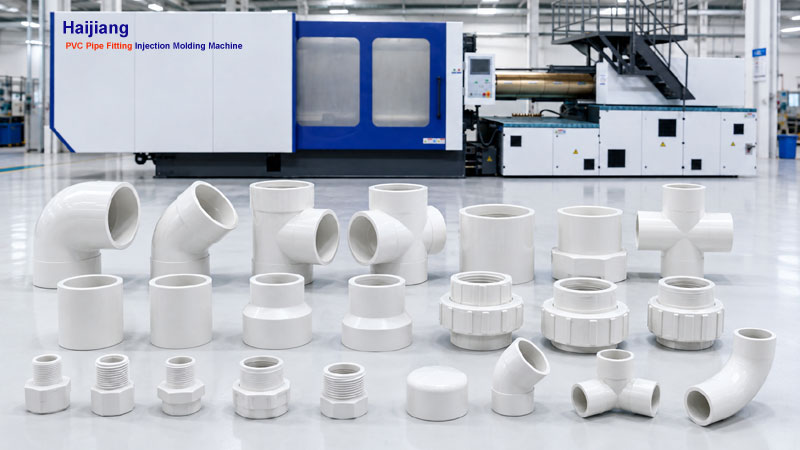
PVC Pipe Fitting Injection Molding Machine
PVC pipe fittings are widely used in water supply, drainage, irrigation, construction, electrical conduit and industrial piping systems. Unlike PVC pipes, which are normally produced by extrusion, most PVC elbows, couplers, tees, sockets, bends and connectors are manufactured by injection molding. A properly configured PVC pipe fitting injection molding machine provides the injection pressure, plasticizing performance, corrosion resistance and process stability required to manufacture consistent PVC fittings. However, producing rigid PVC is more demanding than processing many common plastics because PVC is heat-sensitive, corrosive and has a relatively narrow processing-temperature window. The right production solution therefore involves more than choosing a machine according to clamping force. The fitting design, PVC formulation, shot weight, mold structure, cooling system, screw configuration and process control must all be considered together.
What Is a PVC Pipe Fitting Injection Molding Machine?
A PVC pipe fitting injection molding machine is a specially configured injection molding system used to manufacture rigid or plasticized PVC fittings. Typical products include: PVC elbows PVC couplers and sockets PVC tees PVC reducers PVC unions PVC end caps PVC pipe bends PVC connection fittings Electrical conduit fittings Drainage and water-supply fittings A standard thermoplastic injection molding machine may not be suitable for long-term PVC production without modification. A professional PVC fitting injection moulding machine normally includes a PVC-specific screw and barrel, accurate temperature control, an enlarged hydraulic drive and components designed to resist corrosion. Depending on the product size and mold design, the production system may use a conventional horizontal injection molding machine, a larger two-platen machine or a specialized machine equipped with an enlarged injection unit.
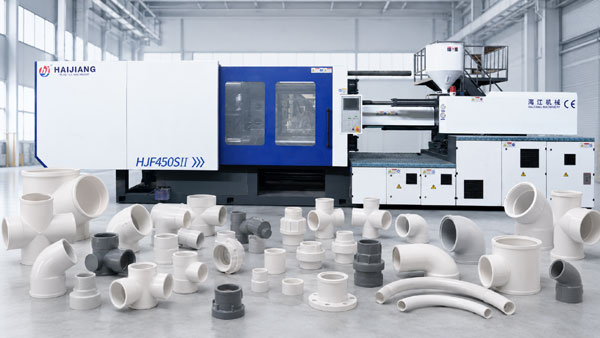
PVC Pipe Production and PVC Fitting Production Are Different
Buyers sometimes search for a PVC pipe injection molding machine, but complete straight PVC pipes are generally made by extrusion rather than injection molding. The usual distinction is: Product Main manufacturing process Straight PVC pipe Extrusion PVC elbow Injection molding PVC coupler or socket Injection molding PVC tee Injection molding PVC reducer Injection molding Electrical conduit fitting Injection molding Special fabricated bend Injection molding, thermoforming or fabrication Therefore, a project producing both pipes and fittings usually requires two production sections: PVC pipe extrusion lines for straight pipes. PVC pipe fitting injection molding machines for elbows, couplers, tees and connectors. Understanding this difference helps investors avoid selecting the wrong equipment and makes it easier to calculate the factory area, power demand, mold investment and required production capacity.
Main Machine Features for PVC Fitting Production
PVC-Specific Screw and Barrel PVC can release corrosive gases if it is overheated or remains inside the barrel for too long. The screw and barrel should therefore use corrosion-resistant materials and a geometry suitable for PVC plasticization. The screw design should reduce excessive shear heat while providing uniform material mixing. Chrome-plated, nitrided or bimetallic components may be selected according to the formulation and expected production conditions. Accurate Temperature Control Rigid PVC has a narrow processing window. Excessive temperature can cause discoloration, burning or material decomposition, while insufficient temperature can lead to poor filling and visible flow marks. A reliable PVC fitting machine should have independent barrel heating zones, effective cooling and accurate temperature sensors. Closed-loop process control helps maintain repeatable production during long operating shifts. Enlarged Injection Capacity Pipe fittings can be thick, heavy and difficult to fill. Machine selection should be based on the total molded-part weight plus runner weight, rather than only on the nominal pipe diameter. The injection unit should provide sufficient shot capacity without operating continuously near its maximum limit. Maintaining a reasonable capacity reserve supports stable plasticization and reduces material residence time. High Injection Pressure PVC fittings with thick walls or long flow paths may require high injection pressure. The machine must deliver adequate pressure and maintain stable injection speed without causing excessive shear or thermal damage. Corrosion-Resistant Components Components that come into contact with hot PVC should be selected for corrosion resistance. This may include the screw, barrel, nozzle, non-return assembly and mold components. Powerful Ejection and Core Pulling Elbows, tees and threaded connectors may have complex internal geometries. The mold can require hydraulic core pulling, unscrewing systems or special ejection mechanisms. The machine should provide sufficient hydraulic circuits and control interfaces for these mold movements.
Products That Can Be Manufactured
PVC Elbows A PVC elbow making machine is an injection molding machine configured with an elbow mold and a suitable injection unit. It can produce 45-degree and 90-degree elbows for drainage, pressure piping, irrigation or electrical applications. The required machine size depends on the fitting diameter, wall thickness, number of mold cavities and total shot weight. A small electrical conduit elbow may use a compact machine, while a large-diameter pressure elbow requires substantially more clamping force and injection capacity. The term PVC elbow machine may refer to the injection molding machine, the mold or the complete production cell. When requesting a quotation, the buyer should clearly specify whether the required price includes the machine, mold, auxiliary equipment and installation. PVC Couplers and Couplings A PVC coupler machine produces straight sockets and connecting fittings used to join two pipes. Depending on the local market, these products may also be called PVC couplings, connectors or sockets. A complete PVC coupler making machine solution generally includes: Injection molding machine Coupler mold Material mixer Hopper loader Mold-temperature controller Water chiller or cooling-water system Crusher for recyclable runners Air compressor, if required Product inspection tools A PVC coupling making machine can use a multi-cavity mold for smaller products. Larger fittings may require fewer cavities because of shot-weight and mold-size limitations. PVC Bends A PVC pipe bend making machine or PVC bend manufacturing machine can refer to different production methods. Small molded bends are commonly produced by injection molding. Some large or long-radius bends may instead be manufactured by heating and bending an extruded PVC pipe. Before choosing a PVC bend pipe machine, determine whether the product is: A molded socket fitting A long-radius pipe bend A pressure fitting A drainage fitting An electrical conduit bend This product definition determines whether an injection molding, thermoforming or pipe-bending solution is more appropriate. PVC Connection Fittings A PVC connection pipe machine normally means a machine producing connectors rather than the straight pipe itself. A suitable PVC connection pipe manufacturing machine can manufacture sockets, unions, adapters, threaded connectors and other pipe-connection components when fitted with the correct mold. Threaded fittings and fittings with complex internal structures may require rotating cores, hydraulic core pulling or collapsible-core mold systems. Electrical Fittings The phrase electric fitting pipe making machine is often used when sourcing equipment for PVC electrical conduit fittings. Typical products include conduit elbows, couplers, junction-box connectors, inspection bends and terminal adapters. Electrical fittings are often smaller and lighter than water-supply fittings. Multi-cavity molds can therefore provide high production output, provided that the injection unit delivers stable shot accuracy and balanced mold filling.
How to Select the Right Machine
A professional supplier normally requires the following information before recommending a machine: Product drawings or clear product photographs PVC fitting type Outside diameter Product dimensions and wall thickness Unit weight Number of mold cavities PVC formulation Required hourly or annual capacity Available electrical standard Required level of automation Calculate the Shot Weight Total shot weight includes the combined weight of all molded products, runners and sprues. The machine’s practical PVC shot capacity should exceed the actual shot requirement by an appropriate margin. PVC shot capacity should not be estimated only from the machine’s published polystyrene shot weight because different materials have different densities and processing characteristics. Check the Clamping Force Clamping force is determined by the projected area of the molded parts and the expected cavity pressure. Large elbows and couplers can require considerable clamping force even if their individual weight appears moderate. Confirm Mold Dimensions The mold must fit between the tie bars and within the minimum and maximum mold-height range. The opening stroke and ejector stroke must also be sufficient for safe product removal and core movement. Match the Production Target A lower-priced machine with a small mold may not be the most economical choice if it cannot achieve the required daily output. Capacity calculations should consider: Number of cavities Molding cycle Working hours per day Working days per year Expected scrap rate Mold-change time Maintenance downtime
PVC Pipe Fittings Manufacturing Process
A typical PVC fitting production process includes the following stages. 1. Raw Material Preparation PVC resin is mixed with stabilizers, lubricants, impact modifiers, processing aids, pigments and other additives according to the intended product standard. The formulation affects flowability, mechanical performance, surface appearance and production stability. The correct hot-and-cold mixer configuration is particularly important when the factory prepares its own dry blend. 2. Material Feeding Prepared material is delivered to the injection molding machine manually or through an automatic feeding system. Moisture, dust and foreign-material contamination should be controlled. 3. Plasticizing and Injection The PVC compound is heated and plasticized inside the screw and barrel, then injected into the closed fitting mold under controlled pressure and speed. 4. Holding and Cooling Holding pressure compensates for material shrinkage while the product cools. The mold-cooling design has a significant effect on cycle time, product dimensions and deformation. 5. Mold Opening and Ejection After cooling, the mold opens and the fitting is ejected. Complex fittings may require cores to move in a programmed sequence before ejection. 6. Trimming and Inspection Operators remove runners or flash and inspect the fittings for short shots, burning, bubbles, sink marks, deformation, color variation and dimensional deviations. 7. Testing and Packaging Depending on the application and relevant standards, finished fittings may undergo dimensional inspection, pressure testing, impact testing, heat-reversion testing or fit testing before packaging.
Equipment Required for PVC Fitting Production
A complete PVC fittings manufacturing machine package can include more than the injection molding machine. Equipment Function Injection molding machine Molds the PVC fitting PVC fitting mold Defines product geometry and cavities Hot and cold mixer Prepares the PVC compound Automatic loader Transfers material to the machine Chiller or cooling system Controls mold and oil temperature Mold-temperature controller Stabilizes mold temperature Air compressor Supplies compressed air where required Crusher Recycles clean runners and rejected parts Cooling tower Rejects heat from the circulating water Testing equipment Checks dimensions and product performance Robot or conveyor Supports automatic part handling The exact configuration depends on whether the factory purchases ready-compounded PVC material or produces its own PVC dry blend.
PVC Pipe Fitting Machine Price
The PVC pipe fitting machine price cannot be determined from the fitting name alone. Two factories producing PVC elbows may need very different machines because of differences in product diameter, weight, cavity number, mold structure and required output. Important price factors include: Machine clamping force Injection-unit size Servo-hydraulic or all-electric drive PVC-specific screw and barrel Corrosion-resistant component grade Number of hydraulic core-pulling circuits Control-system brand Required energy-saving level Automation configuration Mold quantity and complexity Auxiliary-equipment scope Installation and commissioning requirements Shipping destination For the same reasons, a reliable PVC elbow making machine price should be based on an actual elbow drawing and capacity target. A general online price may omit the mold, chiller, mixer, crusher, installation or spare parts. The PVC coupler making machine price is influenced by coupler diameter, weight and cavity number. A multi-cavity mold for small couplers may require a larger injection unit than expected because the total shot weight includes every cavity and the runner system. When evaluating a PVC pipe coupler making machine price, compare complete technical specifications rather than only the machine model or purchase price. Similarly, the PVC bend making machine price and PVC pipe bend machine price depend first on the manufacturing method. A molded fitting, a thermoformed bend and a fabricated large-radius bend require different equipment. A complete PVC fitting manufacturing machine price or PVC pipe fittings making machine price should clearly state whether the quotation includes: Injection molding machine Screw and barrel for PVC Mold Core-pulling functions Auxiliary equipment Material formulation support Installation Operator training Spare parts Warranty Freight and local taxes
Servo-Hydraulic or All-Electric Machine?
Servo-hydraulic machines are widely used for PVC fitting production because they offer strong injection and core-pulling capabilities, flexible mold compatibility and a practical investment level. An all-electric machine can offer high repeatability and lower clean-operation requirements, but its suitability should be evaluated according to fitting size, mold movements, investment budget and local maintenance capability. For many PVC fittings factories, a well-configured servo-hydraulic machine provides an effective balance between energy consumption, production stability, maintenance and initial cost.
Common Production Problems
Material Burning or Discoloration Possible causes include excessive barrel temperature, excessive shear, long residence time, dead spots in the injection unit or material remaining inside the barrel during a production interruption. Short Shots Short shots may result from insufficient material temperature, inadequate injection pressure, restricted gates, poor venting or an injection unit that is too small. Flash Flash can be caused by inadequate clamping force, excessive injection pressure, worn mold surfaces or incorrect mold adjustment. Bubbles and Voids These defects may relate to the PVC formulation, trapped gas, insufficient holding pressure, excessive wall thickness or an unsuitable gate position. Dimensional Instability Unstable dimensions can result from inconsistent material preparation, fluctuating temperatures, uneven cooling, varying holding pressure or premature ejection. The machine, mold, formulation and process settings should therefore be optimized as one production system.
How to Request an Accurate Quotation
To receive an accurate quotation for a PVC pipe fittings manufacturing machine, provide the supplier with: Product names and applications Drawings with complete dimensions Weight of each fitting PVC material formulation or grade Required annual output Expected working hours Preferred mold-cavity number Local voltage and frequency Available cooling-water conditions Required automation level Destination country and delivery port If product drawings are unavailable, physical samples and clear photographs with dimensions can be used for a preliminary machine-and-mold assessment.
Complete PVC Pipe Fitting Production Solution
A successful PVC fittings making machine project should be planned around finished-product requirements rather than around an isolated machine model. A complete solution may cover: Product analysis Capacity calculation Machine selection Mold design PVC material preparation Auxiliary-equipment configuration Factory layout Power and cooling requirements Installation and commissioning Trial production Operator training Maintenance planning This integrated approach reduces the risk of buying a machine that cannot properly fit the mold, achieve the required output or process the selected PVC compound.
Frequently Asked Questions
What machine is used to manufacture PVC pipe fittings? PVC elbows, couplers, tees, reducers and sockets are normally produced by a PVC pipe fitting injection molding machine equipped with a product-specific mold. Straight PVC pipe is usually manufactured by extrusion. Can one machine manufacture elbows and couplers? Yes. One injection molding machine can manufacture different products by changing molds, provided that the machine’s clamping force, shot capacity, tie-bar spacing and core-pulling functions meet the requirements of every mold. What is the difference between a PVC pipe machine and a PVC fitting machine? A PVC pipe machine is generally an extrusion line used to make continuous straight pipe. A PVC pipe fitting machine is usually an injection molding machine used to make elbows, couplers, tees and other individual fittings. What information determines the PVC elbow making machine price? The main factors are elbow diameter, product weight, mold-cavity number, required output, mold structure, machine size, PVC screw-and-barrel configuration and auxiliary equipment. What determines the PVC coupler making machine price? Coupler dimensions, total shot weight, number of cavities, production cycle, mold size and automation level determine the required machine model and final price. Can recycled PVC be used? The possibility and percentage depend on the product standard, intended application, material quality and local regulations. Pressure fittings and safety-critical products generally require stricter raw-material control than non-pressure products. Is a special screw required for PVC? A PVC-specific, corrosion-resistant screw and barrel are strongly recommended. The correct design reduces shear heat, improves plasticization and limits material decomposition. What auxiliary equipment is required? Common auxiliary equipment includes a hot-and-cold mixer, loader, chiller, cooling tower, crusher, air compressor and mold-temperature controller. The final configuration depends on the raw material and production plan. How many fittings can one machine produce per hour? Hourly capacity depends on the number of mold cavities and the molding cycle. It cannot be calculated accurately from machine tonnage alone. Product drawings and mold specifications are required. How do I choose a PVC fitting manufacturing machine? Start with the product drawing, weight, material, cavity number and target output. Then calculate the shot capacity, clamping force, mold dimensions, opening stroke and required core-pulling functions. Conclusion Selecting a PVC pipe fitting injection molding machine requires a coordinated assessment of the product, material, mold, machine and production target. A machine that is suitable for a small electrical coupler may not be suitable for a large pressure elbow, even when both products are made from PVC. Investors should avoid comparing quotations only by clamping tonnage or initial price. The more important questions are whether the proposed system can process PVC safely, accommodate the required molds, maintain stable quality and achieve the planned output with reasonable energy and maintenance costs. By combining the correct injection molding machine, PVC-specific plasticizing unit, well-designed molds and properly sized auxiliary equipment, manufacturers can establish a flexible production line for PVC elbows, couplers, bends, tees, sockets and other connection fittings.
Request a Machine Recommendation
Send your product details and our engineering team will reply with a machine recommendation and quotation.
- · Send the product drawing, sample photo or reference product
- · Tell us the plastic material, product weight and cavity number
- · Our engineers reply with a machine recommendation and quotation